How-to
Filtering
Peptide Test- How to Filter Video: A practical study tested syringe filters (4mm vs 13mm) on reconstituted peptides, measuring volume loss and concentration via HPLC. Key findings: 4mm filters lose ~5-7% volume (0.05-0.07mL from 1mL), while 13mm lose ~28-29% (0.28-0.29mL)—use sma
Peptide Test- How to Filter Video:
A practical study tested syringe filters (4mm vs 13mm) on reconstituted peptides, measuring volume loss and concentration via HPLC. Key findings: 4mm filters lose ~5-7% volume (0.05-0.07mL from 1mL), while 13mm lose ~28-29% (0.28-0.29mL)—use smaller filters for minimal waste. Peptide concentration changes were negligible (< practical impact), with some samples showing slight increases post-filtration (filters retain water, concentrating peptides). Bottom line: Filter for sterility, but choose 4mm PES 0.22µm to preserve yield.
Study Details
Filter Comparison: 4mm = low volume loss (ideal for 1mL vials); 13mm = higher "dead volume" retention.
Concentration Impact: Minimal peptide adsorption; filtration primarily affects volume, not purity/potency.
Practical Tip: Air purge post-filtration recovers extra ~0.01mL from 4mm filters.
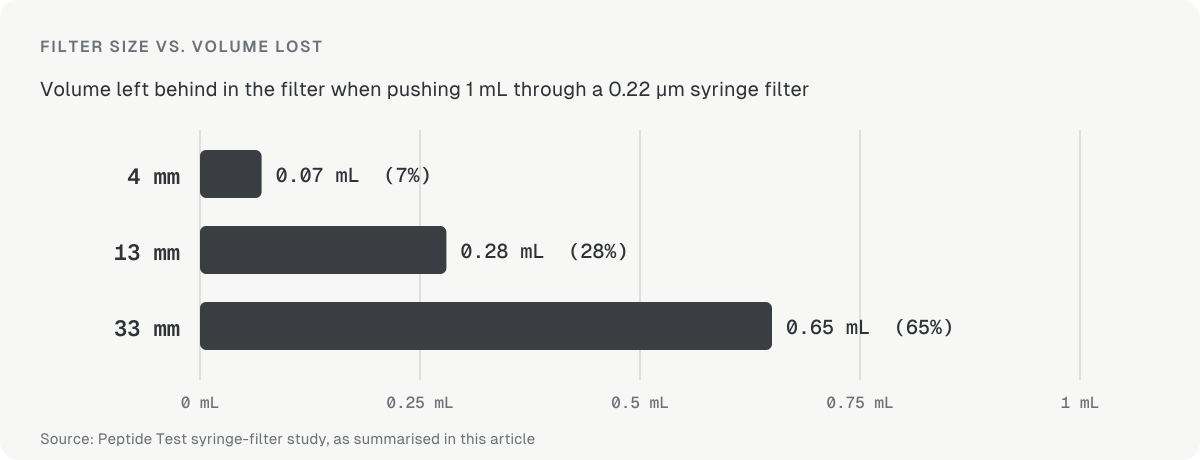
For 0.22 µm filters, the volume lost is:
4mm- Loss of .07ml
13mm- Loss of .28ml
33mm- Loss of .65ml
Full Study completed by Peptide Test: https://drive.google.com/file/d/1jFQsc6O77GApmaLtsufBHP623MnvBfm-/view?pli=1
Here is a video of their 4mm syringe capacity testing: